|


AISIN believes that the basis of its business is to contribute to society through "mono-zukuri (manufacturing)." Therefore, we focus on nurturing human resources in connection with "mono-zukuri (manufacturing)" and impart the concepts, methods and practical skills of "mono-zukuri (manufacturing)" so that we can continue to provide products of assured quality.
Flow of the "Product Design Practicum" for technical staff

Training new engineers
Learning the basics of product development
and design using the sewing machine
In FY2011, AISIN started the "Product Design Practicum" to educate new engineers about the elements and structure of machines using as an example the Group's sewing machine–the point of origin for AISIN–which illustrates the basics of "mono-zukuri (manufacturing)." Trainees go through the planning of their ideas to creation and evaluation of their work to learn first-hand the basics of "mono-zukuri (manufacturing)."
In the practicum, trainees first experience sewing using the first-generation treadle sewing machine of Aisin Seiki and learn its mechanisms. Next, they use a mock-up machine that is three times the ordinary size, with a transparent plastic cover, to learn how a sewing machine functions. Then, three person in a team, they disassemble the latest model machine down to the last piece and re-assemble everything, so as to understand the elements and structure of the machines. After that, they draw diagrams of the parts by hand instead of using CAD, and have prototypes made at Trial Manufacturing Plant. Two months later, the teams come together again when their prototype components are ready, and assemble the parts which they designed themselves, check the functions of their work and evaluate the results. When there are defects, the team comes up with measures to prevent recurrence. By experiencing a series of such practical steps, the employees learn the basics of "mono-zukuri (manufacturing)."
Another characteristic of the practicum is that newly
promoted section managers are appointed as assistants to
the lecturers. By sharing stories during the training session
about the situation at the production sites and past failures,
they help new employees adopt positive attitudes towards
their jobs.

Using treadle sewing machines
first hand instills an understanding
of the passion and mentality of
the inventor.

Mock-up sewing machine three
times the ordinary size with a
transparent plastic cover.
From the Lecturer
What is important is teamwork.
Picking up knowledge and skills is of course important,
but so is recognizing the importance of teamwork.
Becoming a cohesive team leads to better craftsmanship.
We keep reminding the trainees to think independently
and leverage individual strengths, to consult other trainees
and lecturers when facing a problem, and to help each
other, so that each and every trainee is equally involved.
Furthermore, during the sessions, I talk about my own
past failures and tell trainees to be flexible in their thinking,
and not to be embarrassed about raising questions
when they do not know things. I hope thereby to
instill in the trainees the importance of having the right
working attitude.

Tsukasa Ando
Technical Administration Department, Aisin Seiki Co., Ltd.
Training overseas employees at in-house training academy
Developing the local leaders who will spearhead
"mono-zukuri (manufacturing)" abroad
Overseas expansion is one major change concerning
"mono-zukuri (manufacturing)" for Japanese companies,
including AISIN.
We established our first overseas production base in
Mexico in 1973, and the number of overseas production
bases increased every year since then. Now the number
has reached 60.
AISIN focuses on nurturing local manpower into
leaders in "mono-zukuri (manufacturing)" in these overseas
production bases. In FY2002, the in-house training school
Aisin Technical Academy started to receive employees from overseas production bases to teach them practical skills
over the course of one year. When tackling problems in
groups, the curriculum provides for mixed grouping of
trainees from Japan and other countries to enable teamwork
across nationalities and cultures. In FY2011, 20 trainees
from China, Brazil, Thailand, Turkey, Indonesia and Taiwan
were included.
Among the overseas trainees who have completed
their training and returned to their countries, some have
become section heads or managers in manufacturing
divisions, spearheading "mono-zukuri (manufacturing)"
in their countries. AISIN will continue with this training
to impart our "mono-zukuri (manufacturing)" concepts
to people around the world.


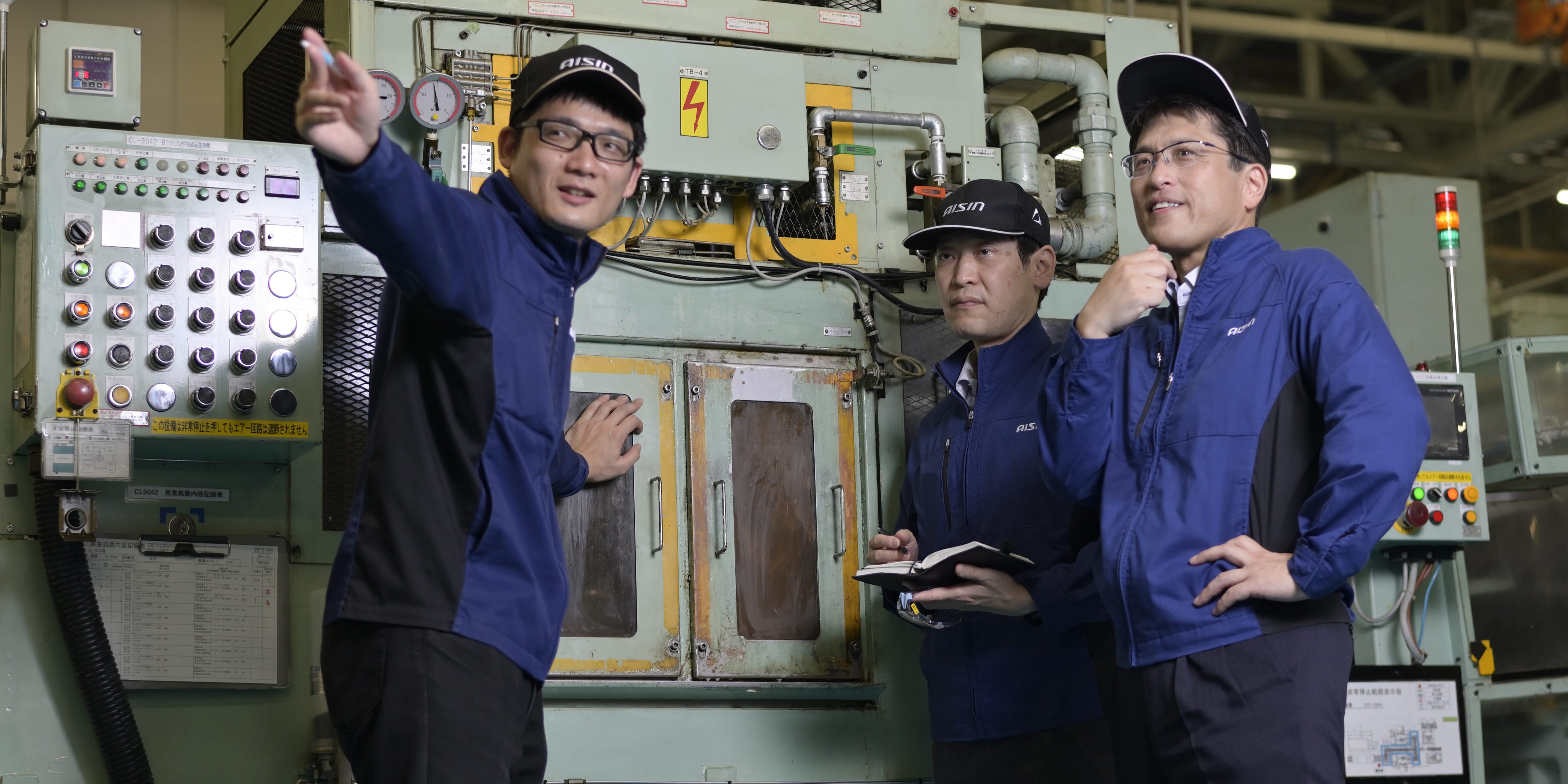
Overseas trainees learning practical skills

|
|