


Message from the President

Truly becoming a
company that creates
value through mobility
From the second founding period and
into the future
President,
Member of the Board of Directors
Moritaka Yoshida
Prologue
What is the value of "movement"? It is a question I have kept asking myself throughout my long career in the automotive industry. There is no single answer, and there is no end to the asking. To prevail amid the currently unfolding once-in-a-century revolution, Aisin Seiki and Aisin AW integrated their management in 2021, and a new Aisin was born. Having become President that same year, I have regarded these five years as our "second founding period" and have pursued reforms accordingly Now our gaze is set on 2035 and beyond. Here I would like to share what we are building and what we are seeking to achieve in these uncertain times.
What we will not change, and what we must change
When I was a child, a new car joined our household. With my father at the wheel, the whole family set off for Lake Biwa.
The newly opened Meishin Expressway, the scenery streaming past the window, my heart racing. As a university student, I drove the first car I ever bought—my beloved chariot—to Hokkaido with friends. A straight road stretching all the way to the horizon. We could go anywhere… Even now, I cannot forget that sense of freedom. The desire to move about freely may be a fundamental human urge, one that humankind has held throughout its long history ever since our ancestors left Africa and spread across the world.
Movement is not merely a matter of connecting one point on a map to another. It brings us to new scenery, connects people with one another and increases our potential. It is the automobile that has brought free movement within closest reach for the most people. That is precisely why people have think of their cars not a mere means of transport but beloved actors in their lives. We live to support that freedom safely, comfortably, and in a way that inspires. That is where the value of mobility that Aisin should create resides.
Entrusted with management in an age when the future seems impenetrable, whenever I find myself hesitating, there is a starting point to which I always return. It is our corporate philosophy “Inspiring ‘movement,’ creating tomorrow,” which we established on the occasion of the integration. This philosophy is the foundation we rely on, one that must never change, however great the period of transformation.
Though we stand atop this unchanging foundation, there are realities that must change. The integration set sail into rough seas, buffeted by the COVID-19 pandemic and a semiconductor shortage. We channeled funds generated by improvements to our existing businesses into electrification and intelligence and pursued a painful weeding-out process. We reevaluated the technologies and expertise each company had cultivated under management across separate companies, redefining them as assets of the Group. We then undertook a major course change toward synergistic group management. As we have advanced along this path, there is one thing of which I have become ever more certain: We at Aisin have the power to create value with regard to “movement.”
Things only Aisin can do
If we liken a car to the human body, the cameras and sensors that recognize the surroundings are the eyes, the semiconductors and ECUs that make the judgments are the brain, and the actuators and drive units responsible for propulsion, steering, and braking are the muscles that move the body. Aisin's true strength lies in producing, on our own, the musculoskeletal organs that provide movement. Propulsion, control, and braking are functions we have continually refined and which let people freely move as they wish while enjoying peace of mind.
We coordinate these muscle elements with our automaker customers, assembling them into systems, and refining their application in actual vehicles at our own proving grounds in Japan and overseas. We call this position, in which we handle everything ourselves from planning and design through implementation and verification, "Tier 0.5." Only a handful of parts manufacturers in the world can go as far as practical vehicle testing and actual driving. One of the few manufacturers capable of creating the value of movement: that is Aisin.
Over many eras, our technologies have created new value and expanded the possibilities of movement for people. Automatic transmissions (ATs) freed drivers from complicated gear shifting and gave even those who had given up on driving the freedom to take to the road. At the Beijing International Automotive Exhibition in the spring of 2026, we demonstrated the application to the vehicle cabin of our Hydraid product (P.45), which was born from our catalyst technology for exhaust gas treatment, thereby revealing a mobility experience that becomes more comfortable and healthier the longer one rides.
Cars of the future will not be able to create value through either hardware or software alone. By combining the muscles (actuators and motor controllers) with the brains (AI and software), we will create integrated, intelligent mobility value that is expressed neither as a component nor as software. That is a role only a Tier 0.5 company can fulfill.
In reaction to the rise of manufacturers in emerging countries and the response to electrification and intelligence, automakers' development resources are under more pressure than ever. What is needed now is not a company that delivers parts, but a partner who participates in the development process and brings answers validated in actual vehicle trials. We will remain a value-creation partner who proposes ideas from the end user's perspective.
The symbol of this is our functionally integrated electric unit (Xin1) motif, which brings together the Group's technologies. It evolves the eAxle concept and is now providing broader utility as a drive unit for battery electric vehicles (BEVs) and, by integrating multiple functions, offers reduced size, higher efficiency, and a lower cost. Because it reduces the batteries a vehicle needs as a whole, enabling weight reduction and greater design freedom, multiple automakers have approached us about it as a proposal that enhances the value of the entire vehicle.
In recognition of these technologies and the value proposition they enable, our business has been able to expand to cover more than 40 automakers worldwide. As we steadily grow our business alongside our principal customer, Toyota Motor Corporation (TOYOTA), we are initiating new transactions with customers around the world at an even faster pace, raising the ratio of sales to buyers other than TOYOTA at a projected rate of approximately 10 percentage points by 2030. We are growing the overall business as we restructure our revenue composition. In the process, we are sharing knowledge amassed across the entire Group. Moreover, we are drawing on collaborations and external partnerships to strengthen our value creation capabilities. This is another thing only Aisin can do and should attract new customers and further enhance our corporate value.
Creating value through mobility
We are not fully meeting the market's expectations when measured against our revenue scale and technological capabilities. Our shareholders and investors give us frank and, at times severe, opinions. It would seem that both our earning power and capital efficiency remain insufficient. Compared with the growth of the automotive industry, the market's valuation of us has been modest. We cannot turn away from this reality. Closing this gap is the key management challenge facing Aisin today. What is being questioned is not the scale of our revenue. It is the ability to maintain earnings even when opposed by headwinds and not being reliant on favorable market conditions or the external environment.
Aisin is amid its transformation into a company that creates value through mobility. By "creation," we mean more than simply fulfilling customers' requests exactly as presented.
We mean building upon the manufacturing base we have constructed under the banner of “quality supremacy” since our founding in 1965 to become a party that introspectively questions, envisions, and creates value through mobility in novel ways that others have not yet considered. From passive "making" to active "creating." This shift lies at the heart of our strategy as we head toward 2035.
The first pillar of value creation is our new-vehicle business, where we have cultivated our technologies and expertise. Here, we will further hone our skills in two domains. One is the domain that supports propulsion, steering, and braking. By combining powertrains, brakes, and integrated electronic control units (ECUs), we enhance basic vehicle performance while helping automakers reduce their development workload and enhance their brand value. The other is the area in which we deliver comfort in mobility. By building sensing, AI, and software into the cabin space, we treat every step from pre-boarding to after arrival as a single experience and deliver safety, comfort, and excitement to our users. By moving beyond functional value into experiential value, we raise the added value of the new-vehicle business itself.
The second pillar is cultivating an earnings base that does not depend on new vehicles. At its core is the aftermarket business. Stewardship over the value of mobility does not end the moment a new vehicle is delivered. For those who drive the same car for many years, we supply carefully selected, reliable replacement parts to the world’s markets, keeping their beloved car running longer and more safely. This contributes to a society that uses resources with care, and it is another form of extracting value from mobility.
We can also cite clean energy technologies that contribute to decarbonization as an area for development, along with other new domains we are exploring as extensions of the expertise we have cultivated with regard to the "power to move things" and control technology. These efforts are not simply a matter of expanding our businesses. They require us to build a strong yet flexible business structure that does not depend excessively on any particular market or any particular power source—even as the automotive industry environment changes rapidly. Which pillars should we establish for 2035 and beyond, drawing on the technologies and customer base we have honed in the new-vehicle business? We are holding ongoing discussions in such forums such as off-site meetings where outside directors and executive management can freely exchange opinions.
The run-up to the future began five years ago. Through restructuring, ROIC has improved to 9.1%, and we have mapped out a path to raise it to 13% or more by FY2031—a level that comfortably exceeds our cost of capital. Over the next three years, we are slated to invest ¥450 billion in growth domains, and total shareholder returns are targeted at ¥300 billion or more. How much of our management resources should be allocated to which areas? We have engaged in frank discussions at the Board of Directors—including regarding the structure of our balance sheet—to verify the appropriateness of these decisions. We reinvest the profits we earn into our future growth and return the results to our shareholders. We believe that ensuring this virtuous cycle of capital is the path to aligning our corporate value with market valuation. We will remain a company that consistently creates value through mobility, whatever sort of era may come: That is my pledge to all our stakeholders, including our shareholders and investors.
Path toward sustainable enhancement of corporate value
Winning even in the face of headwinds
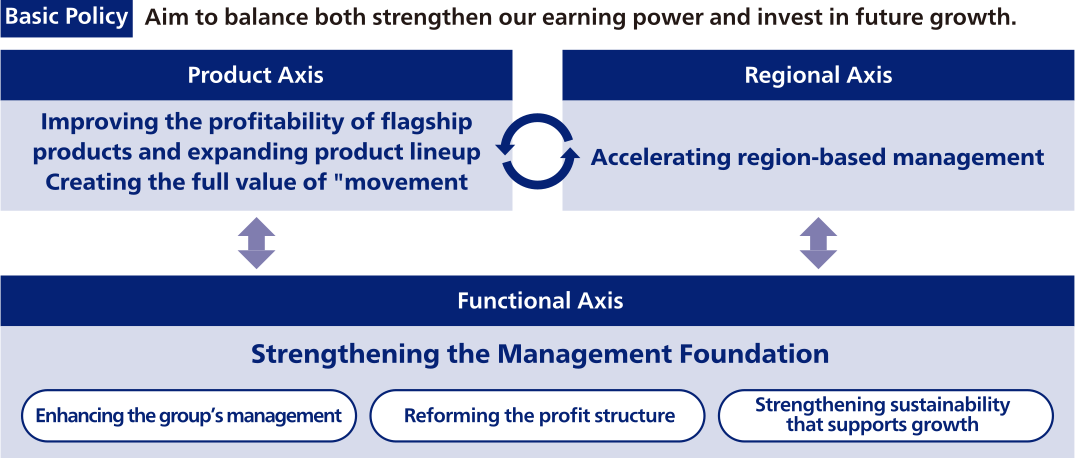
How do we put our strategy into action? The first step is the Medium-Term Business Plan we formulated in February 2026. Geopolitical risks, shifts in energy policy, and the rise of emerging-market manufacturers are key themes. These are not temporary headwinds but structural changes that are fundamentally reshaping the competitive environment. The current situation explains precisely why we have clarified those areas that we intend to develop over the next three years as well as how we will resource them and extract earnings. The Plan proceeds along three axes: product, region, and function.
First we have the regional axis, under which we entrust functions and authority to local management. How do we protect and grow earnings when tariffs, trade policy, and exchange rates introduce volatility? Headquarters sets the key strategies, and the regions, led by senior local management, take the lead in deciding and executing everything from procurement and sales to production. We will ensure robust earnings in each region by, for example, expanding production of hybrid units in North America and of automatic transmissions (ATs) in India. Establishing roots in a region provides learning opportunities. We approach emerging-market manufacturers, with their overwhelming development speed and cost competitiveness, in a spirit of humility and willingness to learn. Working with the local partners in our joint ventures, we are shifting from our conventional mindset that tends to chase high performance to an approach that delivers the value local customers truly want at a reasonable and appropriate cost. By combining what we learn with the quality and reliability cultivated through Japanese monozukuri manufacturing, we will build the strength to compete in the markets that will grow from here.
Next is the product axis, under which we strengthen the profitability of our commercial offerings. As an example, the pace of decarbonization depends on how much energy each country can secure. In some regions, battery electric vehicles (BEVs) are the realistic solution, while in others hybrids (HEVs), plug-in hybrids (PHEVs), and ICE will remain in demand for a long time to come. A single future is not unfolding for the world all at once; multiple futures await different populations. With world-leading powertrain units as our first priority, we are holding to a full-lineup strategy that delivers optimal solutions tailored to individual regions.
This is not insurance taken out because we cannot tell which future will arrive; we are going on the offensive to answer the real needs of each market. Among these, one of the technologies that will drive our future growth, alongside the functionally integrated electric unit (Xin1), is the cooperative regenerative brake system. This technology recovers energy generated during deceleration as electricity, directly improving fuel economy and electrical efficiency. Brakes are safety-critical parts on which lives depend. Because safety verification requires many years and a proven track record, latecomers face a substantial moat. Only a handful of parts manufacturers worldwide have, over many years, refined this technology and the ability to mass-produce it. Aisin is one of them. Our solutions can be fitted to HEV, PHEV, and BEV alike, so whichever power source becomes mainstream, we are ready to capitalize on earnings opportunities while minimizing risk.
Finally, there is the functional axis, which concerns itself with the fundamental strength of the entire company. Our ability to compete in each region and to respond with products can only be sustained if we move resources to where they generate the most value. In integrating such common functional domains as logistics, production, and digital, we must determine where to focus our people, technologies, equipment, and other existing assets. We will assess this on a function-by-function basis and allocate management resources optimally.
Whether the challenge is geopolitics, shifting energy policy, or competition with emerging-market manufacturers, if the three axes mesh together organically, we can fight our way through any headwind. This I believe.
Response to social issues
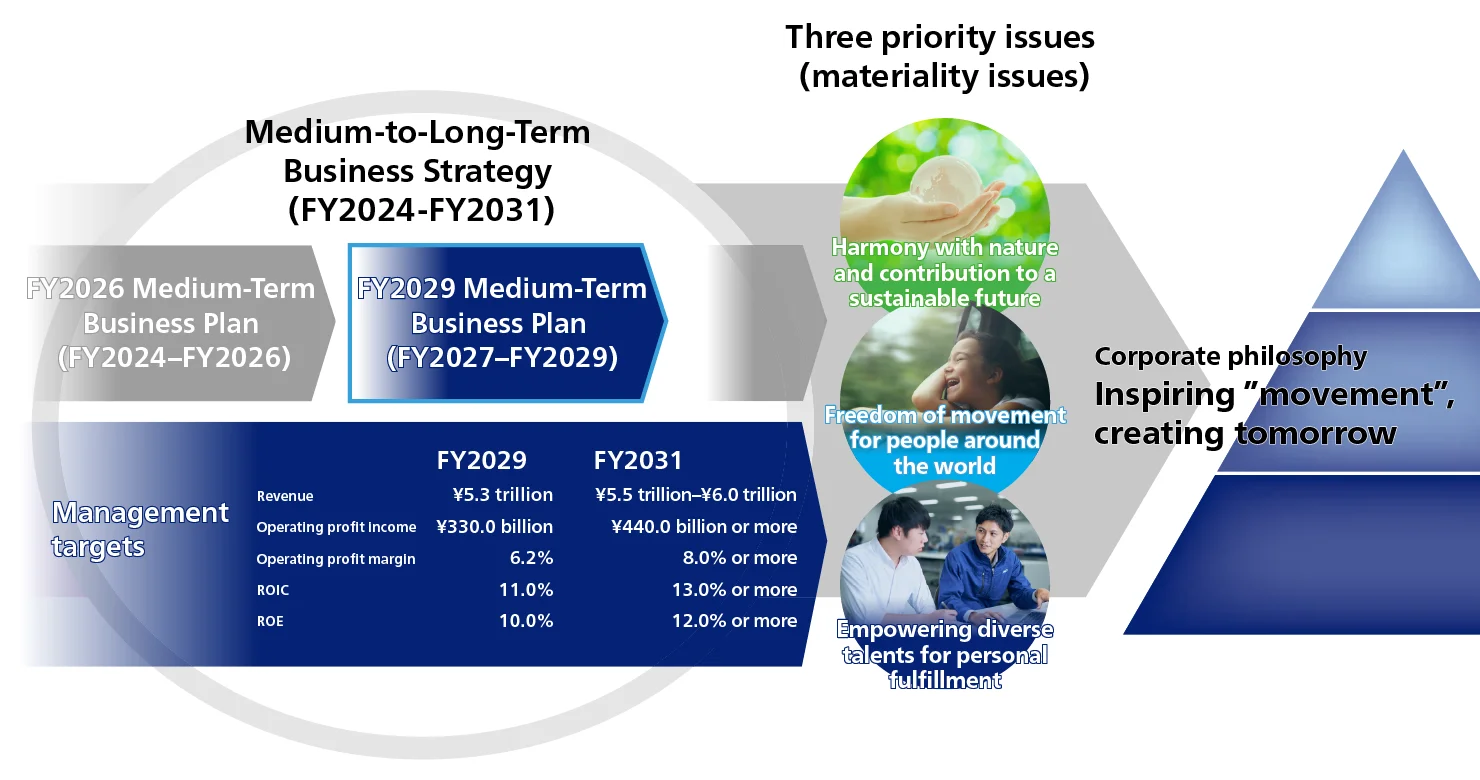
When we pursue, from the customer's perspective, the value of mobility to its limit, we invariably encounter environmental and social issues. That is precisely why I place sustainability at the center of our management effort. Which businesses to operate, which technologies to nurture, which domains to invest in, and which social issues to address as an enterprise—these are key questions that have a critical sustainability element and which determine our medium-to-long-term corporate value.
Choisoko, the AI-powered on-demand transportation service we commercialized according to this line of reasoning, has become an everyday means of getting around for people who have surrendered their driver's licenses and for those living in areas with limited public transportation. Delivering freedom of movement to everyone, regardless of age, gender, or disability; that is a step toward the society we aim to create.
We take the same approach regarding the sustainability of the global environment. We extend the use of technologies designed for vehicle electrification to promote carbon neutrality for society as a whole. Perovskite solar cells, hydrogen generation technology, and Bio-M-Coke® , a bio-briquette coke that replaces coking coal We are implementing the results of our research and these demonstration projects in the field and, beyond simply contributing to the environment, are developing them into a core revenue stream. We believe that addressing social issues offers the opportunity for growth and that providing both social and economic value drives corporate value growth over the long term.
Continuing to question, continuing to challenge
Over the past five years, which we have positioned as our second founding period, we built the foundation for executing our strategy with the help of all our employees. Revenue has reached the ¥5 trillion level, and our operating profit margin has risen, giving us the strength to invest in the future. The functional division system, which removes organizational barriers, has taken root, enabling us to draw on the people, technologies, equipment, and know-how of the entire Group as a single unified asset.
Aisin's corporate value has its origin in the strength of each individual working on the front lines. That is why I have devoted the utmost effort to investing in our people. Rather than increasing our global workforce of approximately 110,000, we are shifting its composition toward growth domains. We plan to increase our software personnel by approximately 40% by FY2031 compared with FY2026, entrust routine work to AI and DX solutions, and have people perform work of higher added value.
Awareness on the front lines is also beginning to change. How can we use the strength of the Group, beyond the boundaries of departments and companies, to create greater value? Our gaze is turning ever outward and farther ahead. Every individual employee, when asked about the value of “movement,” provides an answer through their own work. I believe that the accumulation of these responses will drive Aisin's corporate value forward into the future. To execute management decisions with speed and agility close to the front lines, we revised our management structure this April. I have entrusted two vice presidents with distinct areas of responsibility, while I have shifted my focus to setting the overall direction for the Group, developing the next generation of business leaders, and devising long-term strategies for 2035 and beyond. Precisely because uncertainty is intensifying, we are shifting to team-based management that responds flexibly to change while on the move.
Speed becomes a strength only when it is accompanied by correctness. The role of the Board of Directors is to supervise the fitness and application of strategies created and executed by management. We believe that a healthy balance of tension, in which each party fulfills its respective role, enhances corporate value.
Our leadership team has been joined by new outside directors Yasuhito Hirota, who is highly experienced in corporate management, and Keiko Tatsuwaki, who has deep insight into sustainability. With this addition of objective perspectives from outside the Company, our discussions have become deeper and more varied.
We are working to transition the Board of Directors into a supervisory body that looks beyond short-term, individual decisions. Its new expanded focus considers medium-to-long-term strategies and the allocation of management resources as well as the appropriate oversight of execution and encouragement of prudent risk-taking. Moving forward, we continue to clarify the distinct roles of supervision and execution and accelerate governance reforms aimed at enhancing corporate value.
Technologies that support mobility and management that links these to corporate value: This is the two-pronged strategy that will continue to come up with optimal solutions for each region and each customer. We return the value we create to all of our stakeholders. With these results and challenges at the fore, we strive to create more opportunities than ever to sit down and talk face to face with our shareholders and investors.
There is no end to the main question we are addressing: "What is the value of 'movement'?" We will continue to take on challenges as we protect what must not change and boldly reform that which should.
This is because we believe that movement itself makes people and society happy and brings smiles to people’s faces, whether in the exhilaration I felt traveling at the wheel of a car in my student days, the evolution of technology that challenged me as an engineer, or a future in which people around the world can come and go freely and with peace of mind at any time.
To 2035 and beyond: Please continue to expect great things from Aisin.