TOP > CSR > Environment > Development and Design > Improving the Environmental Features of Life Related Products

Environment

Development and Design / Improving the Environmental Features of Automobiles

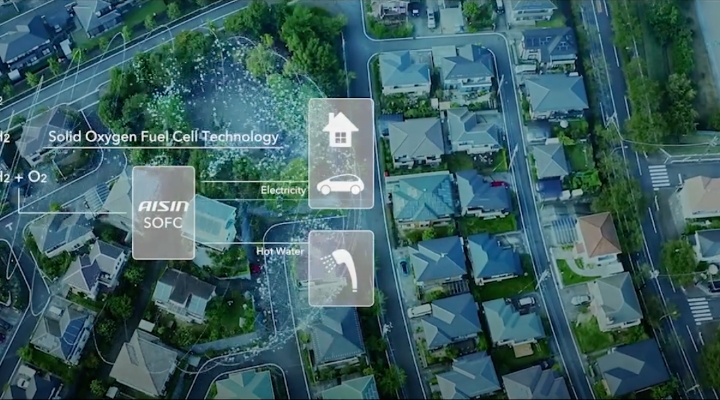
As a means of reducing environmentally hazardous substances, we are reducing resource consumption and developing products that do not contribute to global warming. Examples of such activities include building a unified structure in every stage from production to collection and recycling of beds and reducing CO2 through greater efficiency in GHPs. Moreover, to develop pioneering environmental technologies in energy related products, we are aiming for practical applications for residential fuel cell cogeneration systems.

Development of Dye-sensitized Solar Cells

We have teamed up with Toyota Central R&D Labs, Inc. to develop dye-sensitized solar cells. Currently, we are conducting demonstration experiments aimed at commercialization.

Dye-sensitized solar cells were developed by taking a hint from plants' ability to perform photosynthesis. When light is applied to photo-synthetic pigments in a plant's leaf, electrons are produced to break down CO2 . AISIN developed synthetic pigments to generate electricity and use it for manufacturing, which results in low CO2 emissions (approximately one-tenth of silicon-type generators) as well as keeping the cost of materials and manufacturing equipment low. Further, in addition to the considerable effects that can be gained by a modest amount of sunshine, other unique characteristics of dye-sensitized solar cells include translucency, lustrous color and malleable shapes, thereby offering a wide range of applications from conventional electric generators to building materials.

Toyota Dream House PAPI
Toyota Dream House PAPI, an experimental home proposing one possible future lifestyle (glass face)
Working model of dye-sensitized solar cells on display at the World Expo 2005
Principles and Configuration of Dye-sensitized Solar Cells

Energy Development Department, Aisin Seiki Atsushi Ito
Energy Development Department,
Aisin Seiki
Atsushi Ito

Voice from the Developer

As a manufacturer involved in the automobile industry, we have a keen sense of responsibility towards environmental conservation.

That is why we are working to develop low-cost and environmentally friendly energy products that convert the abundant supply of solar energy into electricity instead of relying on fossil fuels.


Development of Residential Fuel Cell Cogeneration System

We are developing a residential fuel cell cogeneration system that is both highly energy efficient and effective in reducing CO2 emissions. AISIN is participating with Toyota in the large-scale stationary fuel cell verification project promoted by the New Energy and Industrial Technology Development Organization (NEDO). By improving reliability and durability and reducing CO2 in residential fuel cells, we aim to achieve rapid commercialization.

* Jointly developed with Toyota Motor Corporation

AISIN SEIKI Co.,Ltd.
Development of Residential Fuel Cell
Structural Diagram of 1kW Residential Fuel cell cogeneration System

First Delivery of Residential Fuel Cell Cogeneration System

In October 2006, AISIN delivered its first residential fuel cell cogeneration system. A total of 24 units are currently installed in private residences throughout Aichi Prefecture, and verification tests will be conducted over the next two years.

PAGE UP