TOP > CSR > Environment > Environment > Environmental Communication

Environment

Environmental Communication

Raising Environmental Consciousness among Employees Worldwide and Further Promoting Nature and Environmental Conservation Activities


We work to promote more dynamic environmental communication through active environmental information disclosure, environmental exhibits at various events, local town hall-style meetings, environmental seminars for local children and exchanges with local residents.

Building the Handa Plant Biotope

We are building a 2,800m² biotope on the premises of Aisin Seiki's Handa Plant in Aichi Prefecture. From February 2007,together with local elementary school pupils and members of civic organizations, a footpath, aquatic plants and other environmental improvements are being put in place as planned. Almost all of the materials used in the biotope are recycled, including discarded bricks, lumber cut from tree thinning and even water discharged from the plant.

With pheasants laying eggs and huge numbers of water striders, the biotope has gradually been transformed into a home for living organisms. It is also becoming a venue for environmental learning as local elementary students visit to observe nature. We aim to have a grand opening for the biotope, which is being built entirely by hand, in September 2007.


In June 2007, 133 fourth graders from Handa City's Kamezaki Elementary School toured the AISIN Eco Center and took part in creating the biotope. They used recycled bricks to build an Eco Road, planted trees and released fish, while also enjoying digging up potatoes.

Biotope
Biotope
Elementary school pupils building an Eco Road with recycled bricks
 

Promoting Tree Planting for Conservation of Green Areas

Promoting Tree Planting for Conservation of Green Areas

Enlarge Enlarge

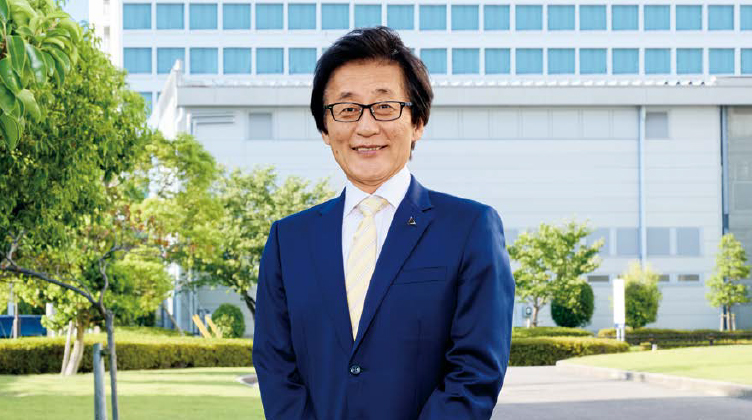
Seiji Mukai

Outside Opinion on AISIN REPORT 2007

Mr. Seiji Mukai

Representative Officer, Green Energy NPO Promotional Organization
Representative Officer, Japan Carbon & Technology Exchange
Part-time lecturer of Nihon Fukushi University,Economics Department (Environmental Management)
Environmental Councilor (Business Department)

It had been a year since I last visited the Handa Plant's biotope and eco farm, but what was then a 2,800m² field adjacent to the AISIN Eco Center on the east side of the plant has now been transformed into a magnificent biotope. This is probably Japan's first full-scale biotope created by a company. Three years have gone by since I first heard about this concept, and the biotope has been gradually but steadily created, quite literally by hand, mainly by staff from the Environment Department. This biotope truly is the crystallization of a tremendous amount of hard work and knowledge.

The biotope displays an amazingly comprehensive level of consideration to the environment. An example of this is the biotope's design: plant wastewater is discharged after being purified using water treatment equipment, which is further filtered through net bags of brick debris so that the quality of the water in the stream is clean enough to provide a habitat for killifish. Cut trees thinned from Neba Village are used to make bridges, chairs and tables. The biotope's Eco Road has been paved with used pallets and recycled bricks. AISIN employees brought unneeded plants and planted them by hand in the biotope. Used concrete has been used to serve as garden rocks. I am deeply impressed that this garden is heading for completion without investing a large amount of capital. I believe this biotope can serve as a model for a future recycling society, and I really look forward to visiting again a year later.

Nutrient-rich soil for the eco farm, where potatoes and a variety of vegetables are thriving, was developed thanks to fully fermented compost created from the annual 276 tons of leftover foods recovered from Group plants. Being interested in cultivating chemical-free vegetables myself, I tried some of this compost in my own garden, and it seems to be good for growing vegetables.

During a lull in the rainy season on a late Sunday afternoon, I attended the opening ceremony of “Hotaru no Yube,” an event to celebrate fireflies at the biotope. Employees and their families, children from social welfare institutions and residents from Neba Village involved in forest conservation all joined in to spend an enjoyable time together.

I have heard that AISIN's policy is that this biotope should serve as a future site for environmental education of local elementarychool children and fostering communication among the region's residents. This kind of social activity is essential for companies to coexist within local communities as well as have a necessary existence for society.

I'd like to extend my fullest congratulations on the occasion of the opening of this biotope, a fitting symbol of AISIN, which is especially recognized as a passionate environment-conscious company among the companies of the Toyota Group.

This biotope will serve as a symbol of AISIN's environmental activities, and in turn support its aim to be a top environmental player in the automotive industry as well as throughout Japanese industry. It is my sincere hope that AISIN will steadily move forward with ingenuity and passion.

Implementation of “Backyard Tours” for Visiting Environmental Facilities

In July 2006, 28 students from Morowa Junior High School in Togo-cho, Aichi, visited the head office of Aisin Seiki as Yomiuri Shimbun Junior Correspondents. They toured the environmental facilities of the Kariya Plant, including observing rooftop greenification, solar and wind power systems and a wastewater treatment system. Participants also interviewed Executive Vice President Minoru Hayashi in relation to the company's environmental initiatives.

The number of people wanting to visit our environmental facilities is increasing since a public announcement was made via the media. In fiscal 2007, a total of 783 persons from 15 organizations visited the company.

Tour of rooftop greenification efforts and wind power system
Wastewater treatment
Observing wastewater treatment experiment

Exhibiting at Eco-Products 2006

Aisin Seiki displayed and introduced its dye-sensitized solar cells, fuel cells, fuel cell cogeneration systems and other clean energy devices at Eco-Products 2006, Japan's largest environmental trade show featuring exhibits by 550 companies held at Tokyo Big Sight in December 2006. As a means of publicizing conducted public relations activities such as an eco quiz aimed at rapidly expanding numbers of elementary, junior and high school students as well as visitors in general. At the 2006 event, the number of visitors to the AISIN booth almost doubled that of the previous year.

Exhibiting at Eco-Products 2006
AISIN booth : Exhibiting at Eco-Products 2006

Number of Visitors at Eco-Products 2006

  2004 2005 2006
Total visitors (persons) 124,000 140,000 152,000
AISIN booth visitors (persons) 1,350 1,580 3,510
PAGE UP