

Turning More Than 30 Years of Technology into Social Value The World's First Compact NMR System, Built on Superconducting and Cryogenic Technologies
Sep.30, 2026
NMR (Nuclear Magnetic Resonance) systems are analytical instruments used to examine the composition and molecular structure of pharmaceuticals, chemical materials, and food products. Using the same magnetic resonance principle as MRI systems used in medical applications, they support research, development, and quality evaluation. High-performance NMR systems, however, are typically large and burdensome to install and maintain.
To address this issue, AISIN leveraged the superconducting and ultra-low-temperature refrigeration technologies it had cultivated over many years. Through research with RIKEN and joint development of the system’s spectrometer with JEOL Ltd., it commercialized the world’s first* compact, high-performance NMR system.
*1 The first commercialized 200 MHz-class NMR system utilizing a bulk superconducting magnet.
In its 2028 Medium-Term Management Plan, AISIN has set out to strengthen its earning power while continuing to invest in future growth. This initiative is an effort to turn the groundwork laid through years of research into value that can be put to use in society and developed into a new business. In this article, we explore that journey and the new possibilities it brings to research.
The Missing Middle Between Large and Benchtop NMR Systems
NMR systems are used to examine the composition of substances at the molecular level, enabling researchers to verify whether pharmaceuticals have been synthesized correctly or identify the components contained in new materials. Although not widely known outside the scientific community, these systems support research across a wide range of fields, including pharmaceuticals, chemistry, food science, and materials development.
As analyses become more detailed, stronger magnetic fields are required. Conventional high-performance NMR systems generate these fields by cooling superconducting coils to extremely low temperatures using liquid helium. Because additional equipment is needed for cooling and thermal insulation, the systems tend to be large and heavy. Their size and the need to manage magnetic field leakage also necessitate dedicated rooms. Even after installation, replenishing coolant and maintaining the systems place a considerable burden on users.
By contrast, benchtop NMR systems that use permanent magnets are compact and easy to operate, but their magnetic field strength is limited, restricting the range of analyses and applications they can support. In other words, users have traditionally faced two choices: high-performance systems that are large and difficult to handle, or convenient systems with limited capabilities. There was no adequate solution in between.
“There was a segment where users did not require a large, high-performance system, yet found benchtop systems insufficient,” explains Toshihiko Ishida, who leads the Design & Development Group. “We aimed not only to meet those needs, but also to turn our decades of superconducting and cryogenic expertise into new value for society.”
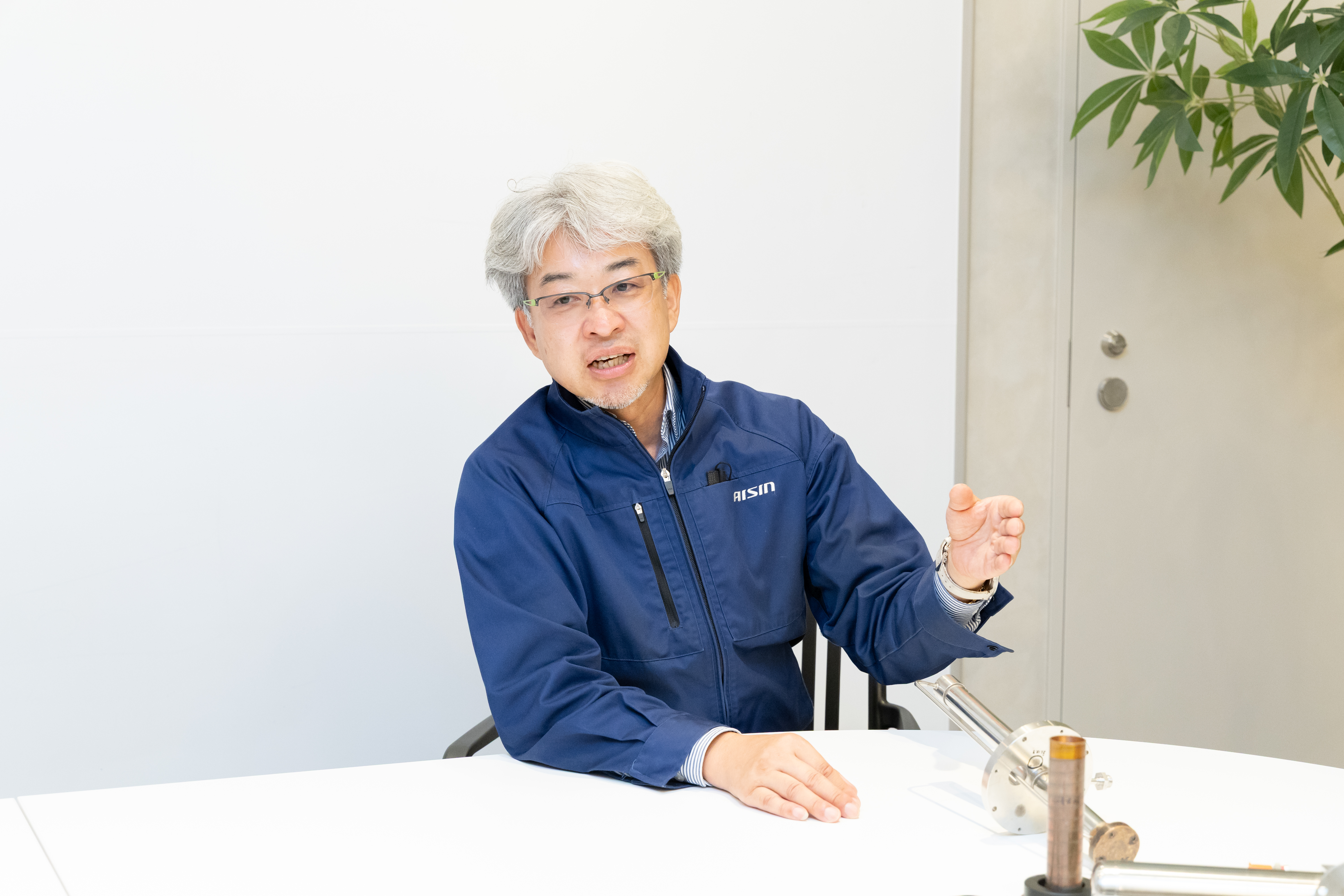
Ishida, leader of the development team.
Through many years of research with RIKEN, AISIN refined its technologies and, through joint development with JEOL Ltd., * commercialized a compact, high-performance 200 MHz-class NMR system that fills this gap. With a footprint small enough to fit beside a desk, the system can be easily introduced into laboratories and production sites where conventional NMR systems have been difficult to install. As a result, it expands the options available for research, development, and quality evaluation.
*2 JEOL Ltd.: One of Japan’s leading manufacturers of scientific measurement and industrial instruments, offering analytical equipment such as electron microscopes and NMR systems. It operates globally, supporting research and development around the world.
So how did superconducting and cryogenic technologies ultimately lead to the development of an NMR system?
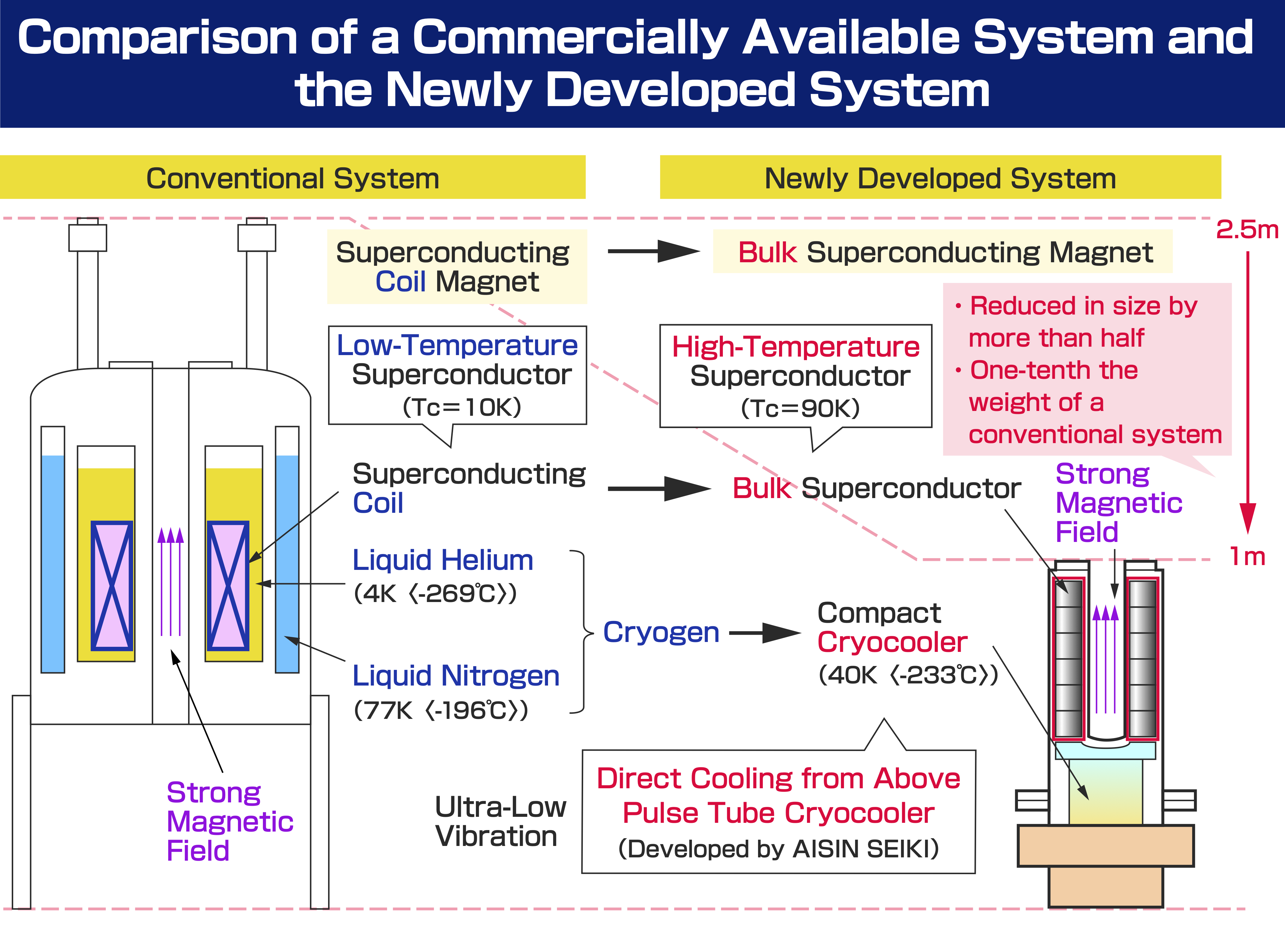
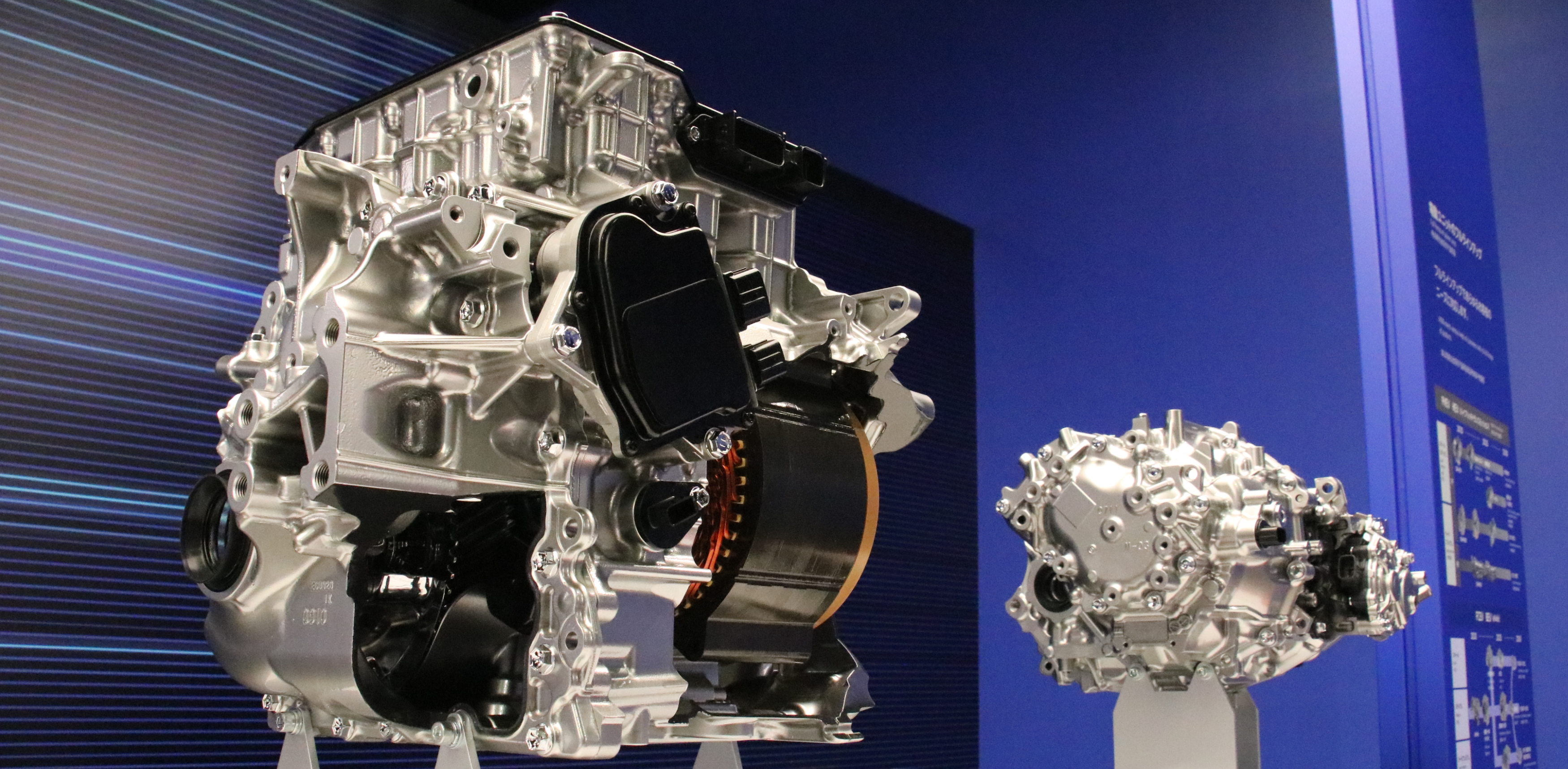
Conventional system (left) and the newly developed system (right). The height was reduced from approximately 2.5 m to about 1 m, while the weight was cut to less than one-tenth that of the conventional system.
Where Bulk Superconductors Met Research Needs
The compact NMR system was not part of AISIN’s original plan. For many years, the company’s focus had been on exploring the potential of a new technology known as superconductivity.
In the late 1980s, a series of new materials capable of achieving superconductivity, a phenomenon in which electrical resistance disappears, at higher temperatures than previously possible were discovered. These materials became known as high-temperature superconductors. Although “high temperature” still meant temperatures below −183°C, it represented a significant improvement over conventional superconductors, which required cooling to around −263°C. This reduced the burden of cooling and opened up possibilities for applying superconducting technology to a wider range of products.
Recognizing the potential of this technology, AISIN launched research aimed at understanding its unique characteristics and identifying pathways to commercialization through products that could contribute to society. In 1991, the company established IMRA Material R&D Co., Ltd. (later IMRA Japan Co., Ltd.). One of the researchers seconded there was Yoshitaka Ito.
Ito devoted himself to exploring the properties and potential applications of bulk superconductors. While he confirmed their ability to generate and maintain strong magnetic fields in a compact form, finding an application that could fully capitalize on those advantages proved far from easy.
In 1998, as AISIN was exploring a range of potential applications, including motors and magnetic separation systems, it reached a turning point in the form of an encounter with RIKEN. Through discussions with researchers there, a challenge facing the scientific community came into focus: Could high-performance NMR systems be made smaller?
NMR systems required strong magnetic fields, and bulk superconductors were capable of generating strong magnetic fields with relatively small magnets. It was at this intersection that the technology AISIN had been refining for years met a real-world challenge in the research field.
“We thought that bulk superconductors might be able to generate magnetic fields as strong as those of conventional systems with much smaller magnets,” recalls Yoshitaka Ito. “For the first time, I felt we had found a real-world application for the technology we had been pursuing for so many years, one that could address a challenge facing researchers. We began to see a path toward using bulk superconductors as magnets for NMR systems, and that led us to launch joint research with RIKEN on NMR magnets.”
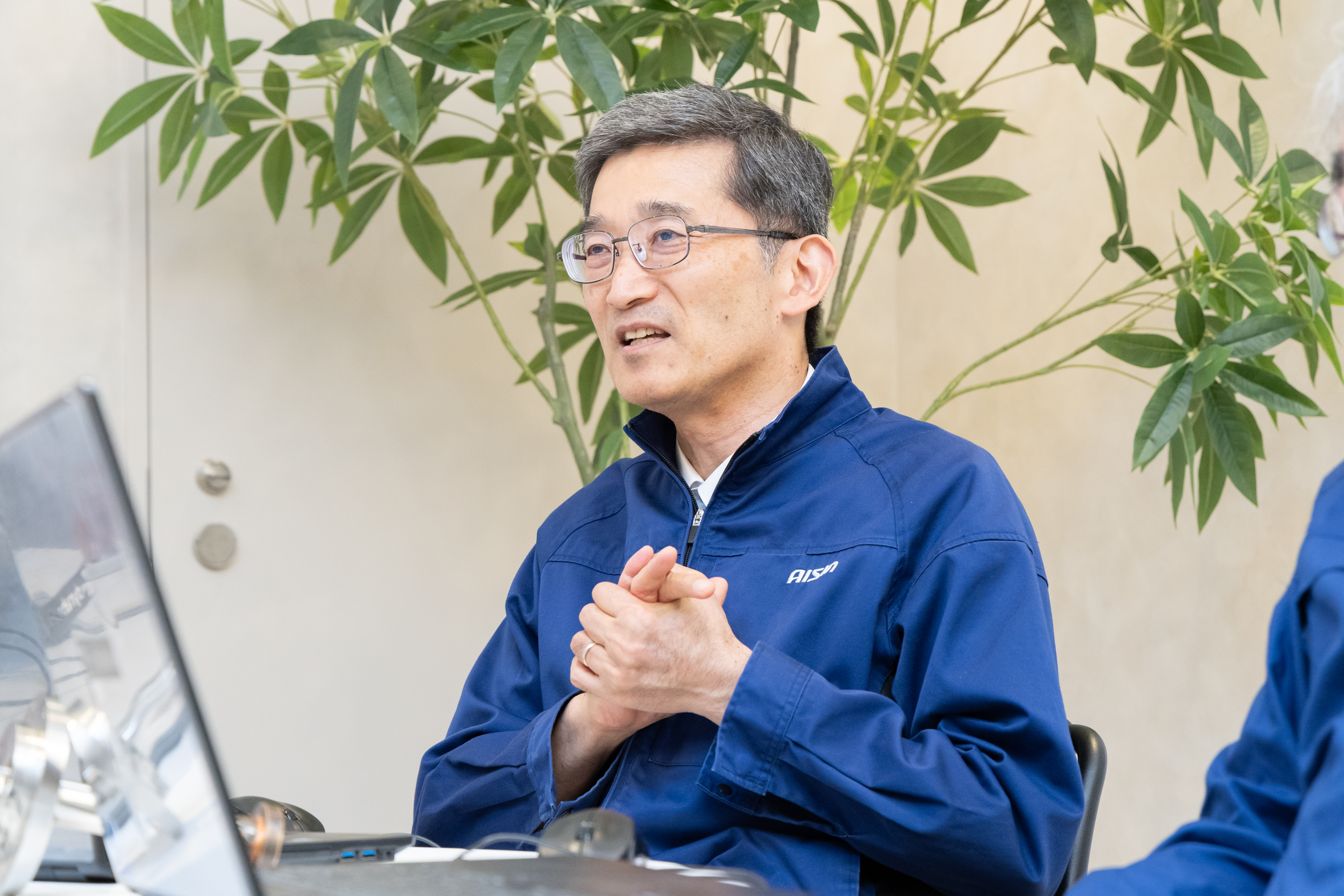
Yoshitaka Ito, who has dedicated more than 30 years to advancing superconducting technology
AISIN also possessed another key technology: cryogenic refrigeration for keeping superconducting materials at low temperatures. Its roots trace back to refrigeration systems developed for magnetic levitation trains in the 1970s. Over the following decades, the company continued to explore multiple refrigeration methods for different applications, steadily refining technologies capable of achieving and maintaining extremely low temperatures.
The person leading the development of these cryogenic systems was Yuji Okubo.
“Like superconducting technology, we spent years nurturing this technology while searching for ways it could make a meaningful impact in the real world,” says Yuji Okubo.
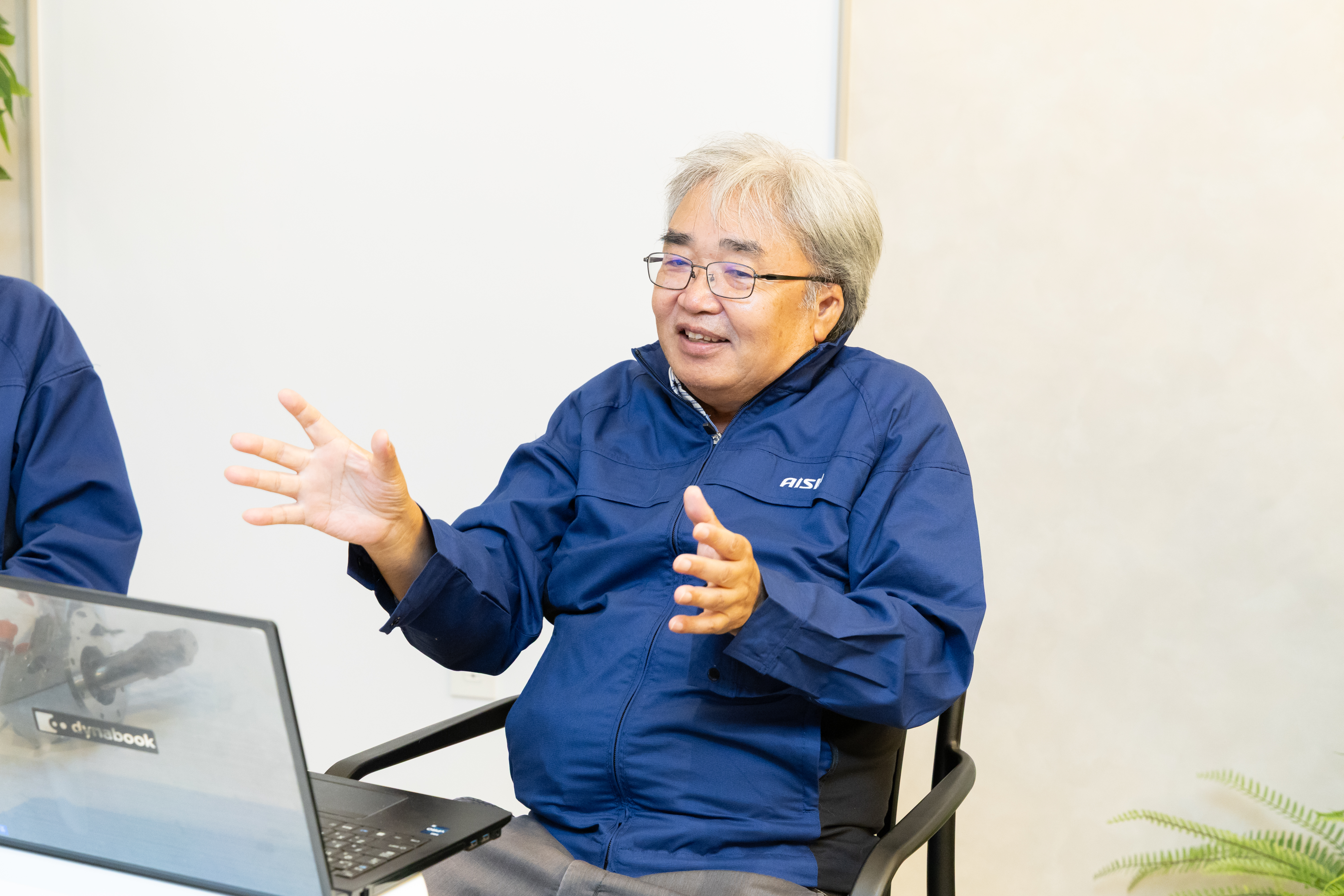
Yuji Okubo, who contributed to improving the technology as an expert in cryogenic refrigeration systems
Bulk superconductors, capable of generating strong magnetic fields despite their compact size, and cryogenic refrigeration technology, which keeps them at extremely low temperatures, had been developed separately. NMR brought these two technologies together in an entirely new application.
After years of research, the team succeeded in detecting an NMR signal from a bulk superconducting magnet for the first time in 2007. However, a major obstacle still stood in the way of commercialization: achieving the magnetic field uniformity required for practical use.
After Years of Trial and Error, a Breakthrough Emerges
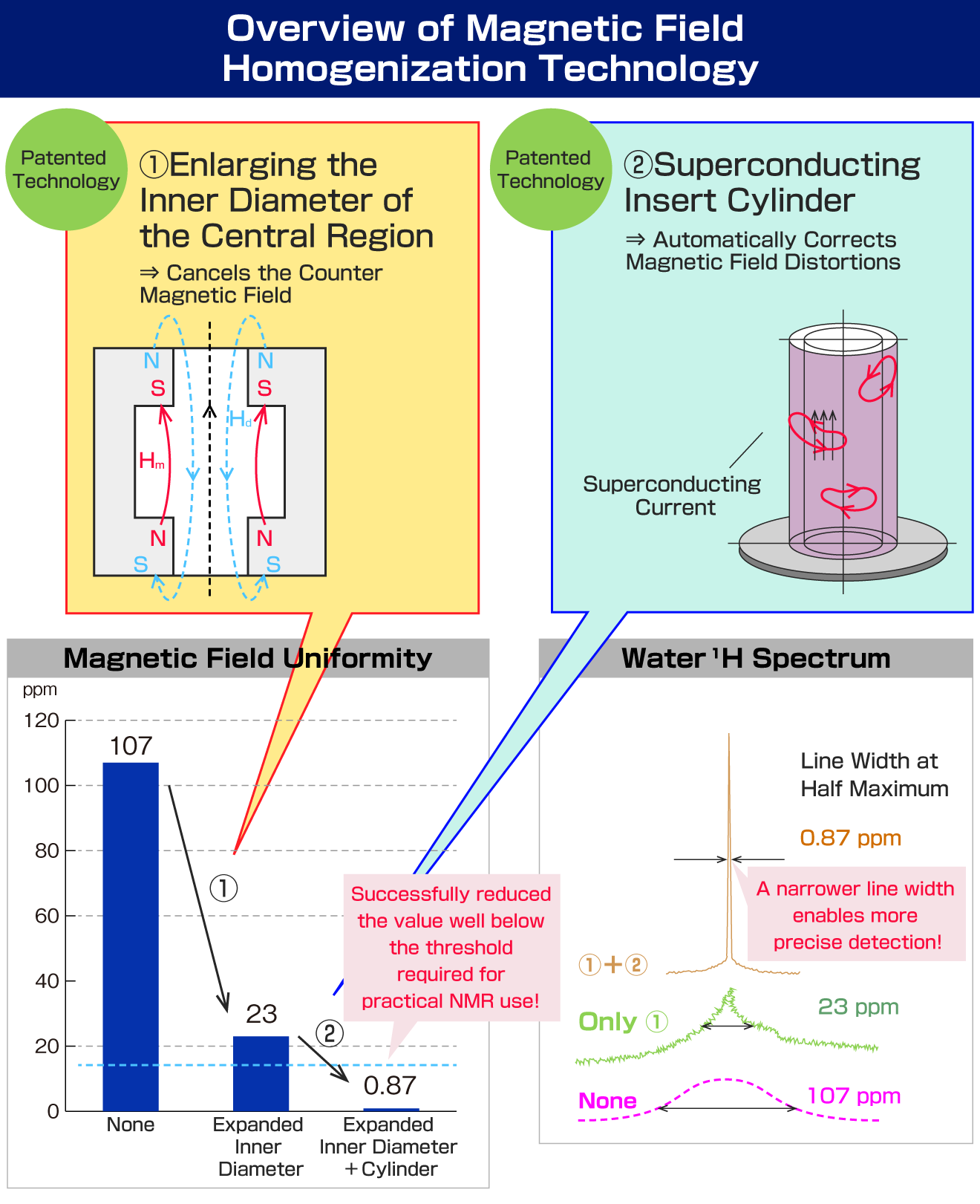
What NMR magnets require is not only a strong magnetic field, but also an extremely uniform one, with variations controlled to within one part per million. Even slight irregularities can blur the peaks that appear in measurement results, making it difficult to accurately distinguish between neighboring components.
While bulk superconductors excel at generating strong magnetic fields, achieving magnetic field uniformity presented a major challenge. Bulk superconductors are ceramic materials, and their internal structure contains microscopic gaps and variations. These irregularities can cause uneven current flow, which in turn leads to distortions in the magnetic field they produce. As a result, attaining the level of magnetic field uniformity required for NMR was far from straightforward.
From that point on, Ito and his colleagues embarked on a long process of trial and error. They repeatedly modified the structure and shape of the bulk superconductors and brought prototype magnets to RIKEN for testing, but time and again, the results fell short of what was needed for practical NMR applications.
“To be honest, it was extremely difficult. But I believed that miniaturization could only be achieved with bulk superconductors. My determination to make it work, no matter what, was what kept me going,” recalls Yoshitaka Ito.
The breakthrough came when the team moved away from the idea that bulk superconductors alone had to solve every challenge. What if bulk superconductors could be responsible for generating the strong magnetic field, while another superconducting material handled magnetic field uniformity? With that in mind, Ito devised a cylindrical component made from a highly uniform superconducting tape.
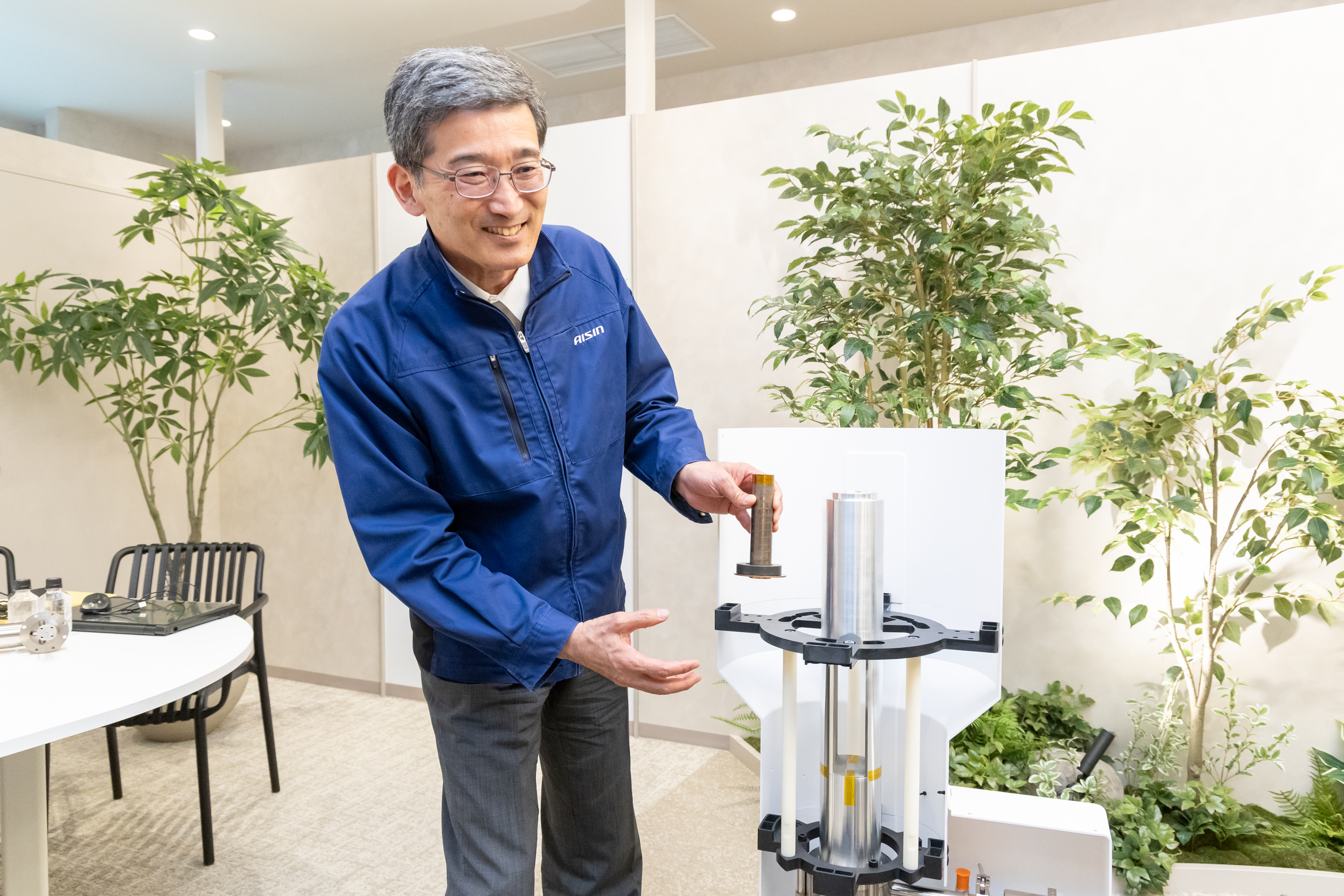
The compact NMR system, completed after years of trial and error
By incorporating this component inside the bulk superconductor, the team created a hybrid structure that automatically compensated for distortions in the magnetic field. In 2014, this hybrid design dramatically improved magnetic field uniformity, resulting in sharply defined measurement signals. Continued refinements followed, ultimately achieving the level of uniformity required for NMR applications.
Another essential technology for putting bulk superconductors into practical use was cryogenic refrigeration. To maintain the superconducting state, the magnet must be continuously cooled to approximately 40 K (-233°C). At the same time, vibrations generated by the refrigeration system must be minimized so that they do not interfere with measurements.
The technology that made this possible was the pulse tube cryocooler, which AISIN had been developing for many years. The team modified the conventional water-cooled design into an air-cooled system better suited for laboratory use. They also developed a structure that allows samples and detection components to pass through the system while enabling the magnet, located at a distance, to be cooled from below.
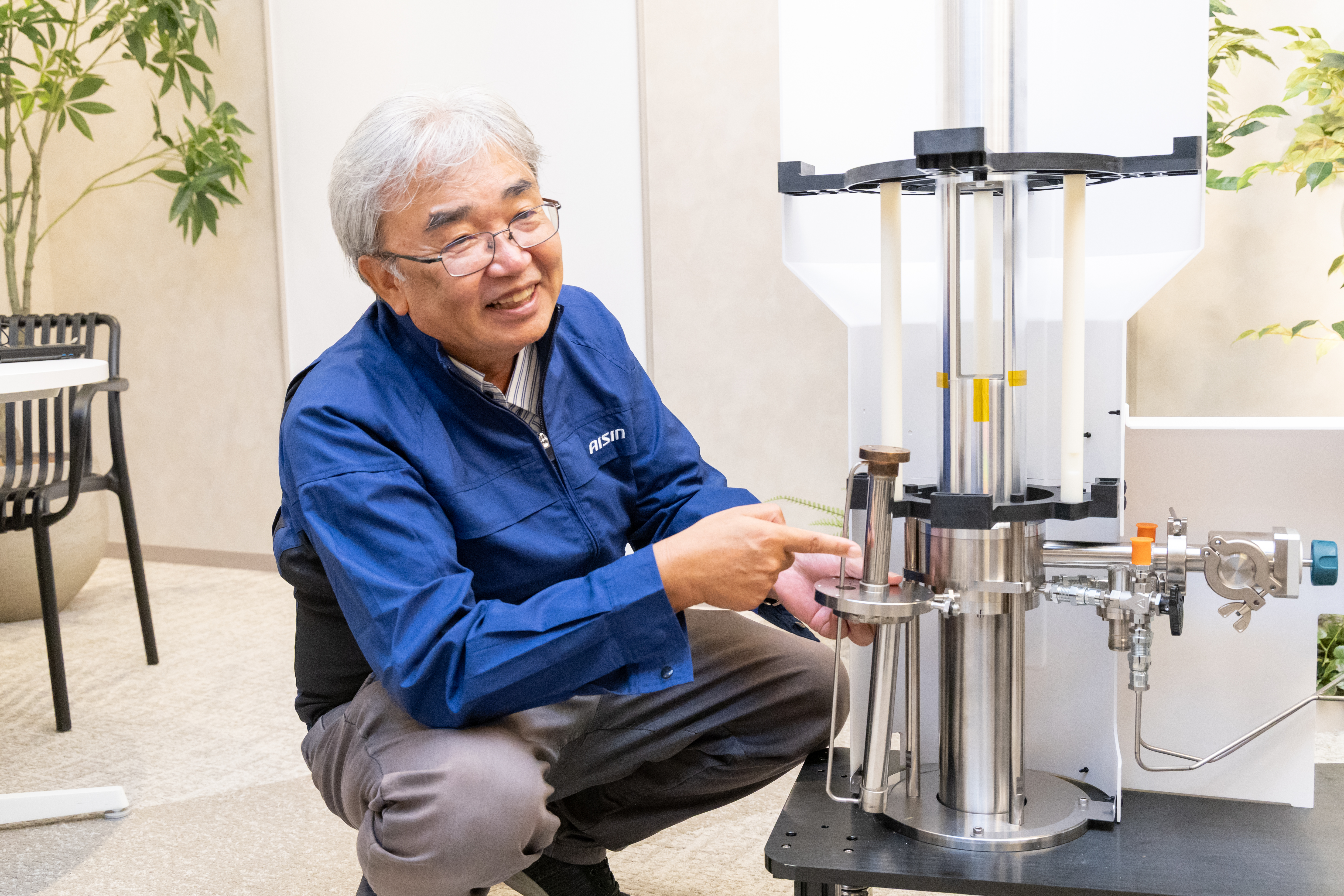
Establishing the refrigeration system architecture was a key step toward making the compact NMR system a reality.
Looking back, Yuji Okubo, who has spent much of his career working on cryogenic refrigeration systems since joining AISIN, reflects on the journey with a sense of pride.
“This cryocooler incorporates not only test data accumulated through past development efforts, but also the knowledge and expertise of many colleagues who have since retired,” says Yuji Okubo. “By combining strengths from different fields, we steadily brought the compact NMR system closer to commercialization. Even in advanced development projects where results are not immediately visible, we had an environment that allowed us to keep working toward long-term goals. I believe that was a major reason we were able to pass our R&D knowledge and expertise from one generation to the next.”
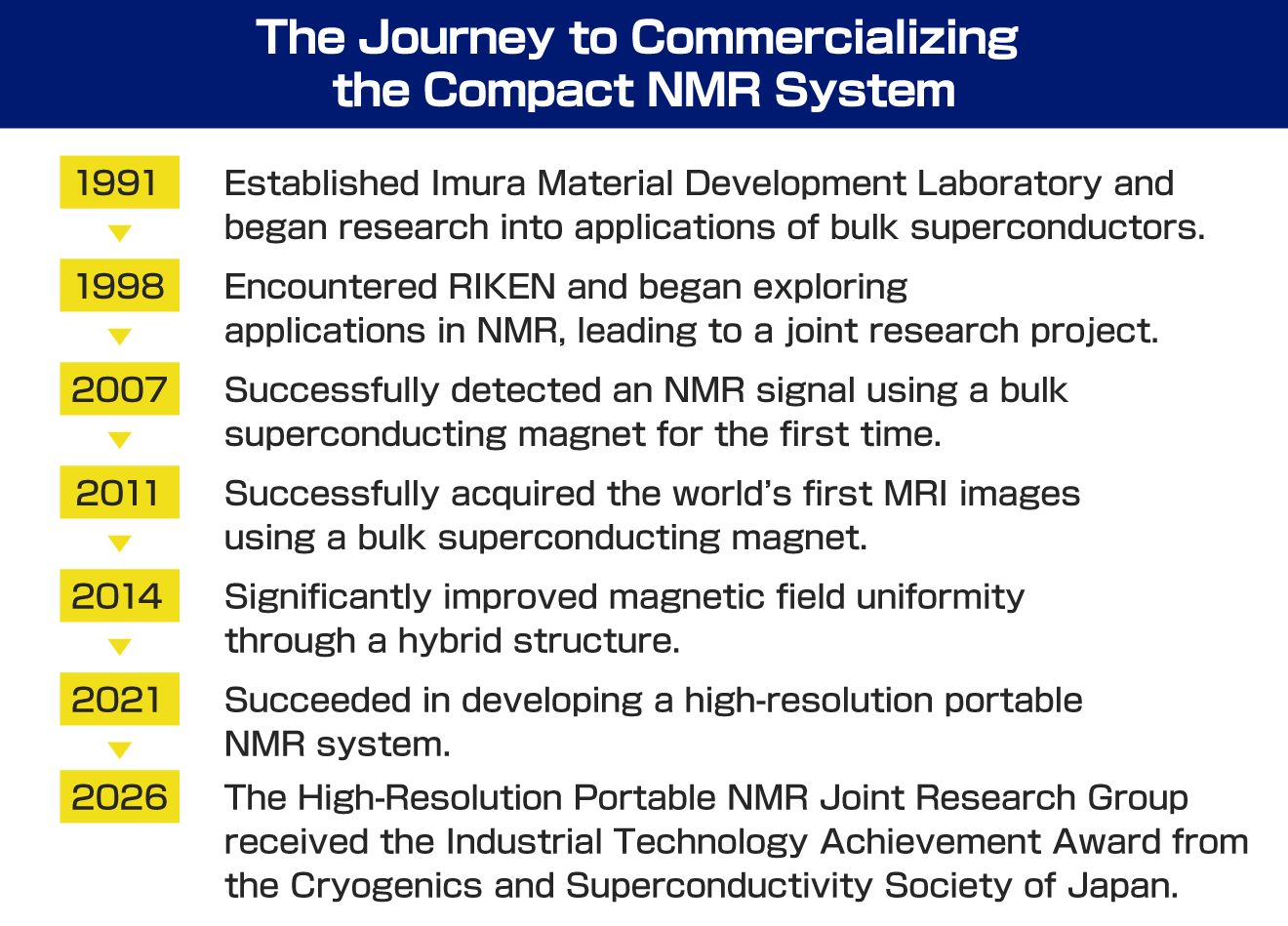
More than 30 years passed before the compact NMR system reached the market. Let’s look back on that journey.
Turning Technology into Business, Together.Commercialization Begins a New Chapter
In 2021, the results of the research were transferred to AISIN as the foundation for a new business, and full-scale efforts toward commercialization began. Yet turning a technology into a product that customers can actually use requires more than technical excellence. Stable performance is essential, but so are transportation, installation, quality assurance, and maintenance. Only when all of these elements are in place can a product be delivered on an ongoing basis.
Working closely with its joint development partner, JEOL Ltd., the development group integrated components such as a detector optimized for the compact magnet, gradually refining the system into a fully functional analytical instrument. At the same time, the team enlisted the support of numerous stakeholders for tasks ranging from prototyping and design to other aspects of product development, steadily laying the groundwork for commercialization.
Throughout the process, Ishida focused on transforming the outcomes of the research into value that customers could actually use.
“No matter how outstanding a technology may be, that alone does not make it a business,” he explains. “We needed to prove that customers would genuinely find value in it, and that we could continue delivering over the long term, supported not only by product quality but also by service. That was something we had to demonstrate for ourselves.”
The team carefully prepared every step of the process, from signing the contract with the first customer and providing technical support to packaging, transportation, and on-site installation. They repeatedly rehearsed the installation process and verified that the system operated properly at the customer’s site. The moment they received the customer’s acceptance sign-off, years of research had, for the first time, become something a customer could put to use.
“We would never have made it this far through the efforts of researchers alone. The support of so many colleagues across AISIN was equally essential. Even when this initiative was still largely unknown, many people believed in its potential and contributed in their own ways. Commercialization is not the goal. It is the first step in bringing the technologies we have cultivated over many years to society as a business.”
Two technologies, refined over more than 30 years, ultimately came together in the form of the compact NMR system. Today, the team is already looking ahead, exploring how these technologies can be applied to address the next generation of social challenges and create new business opportunities. The journey does not end here. The next challenge has already begun.
Share this article