
1Perovskite solar cell
For perovskite solar cells, we conduct R&D on hole transport materials with high performance, high durability, and reasonable cost by utilizing technologies for dye-sensitized solar cells. We are also developing construction methods and materials in anticipation of the solar panels of larger size.
![[Power generation principle of perovskite solar cell]](../../assets/img/development/energy-sec1-img1-en.png)
- [1] The light absorbing layer (perovskite crystal) absorbs sunlight and generates electrons and holes, which move to the transparent photoelectrode and counter electrode on the backside, respectively.
- [2] Electrons move through the transparent photoelectrode and through the load to the counter electrode.
- [3] Electrons moved to the counter electrode combine with holes.
[Research outcome (example)]
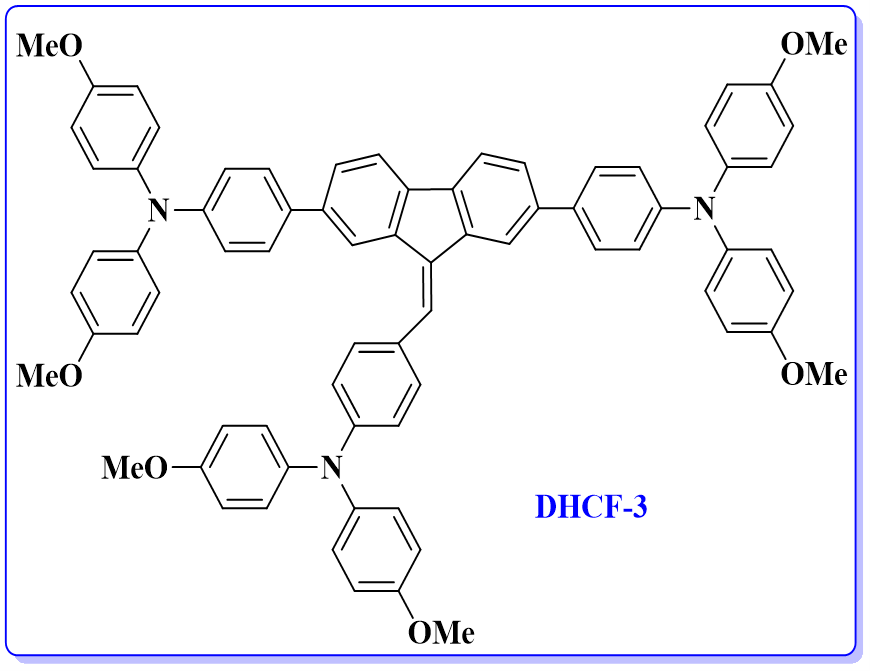
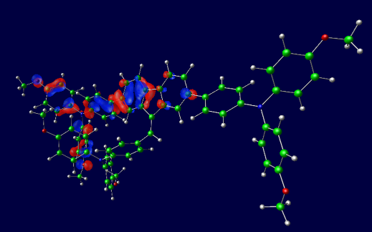
Perovskite solar cells generate electricity by separating electrons and holes (positive holes) excited by light absorption in the perovskite crystal layer and extracting them to the outside. For efficient power generation, it is important to have a P-type semiconductor layer (hole transport layer) that can quickly transport generated holes. We have developed a new hole transport material, DHCF-3, using our expertise in organic semiconductors that we have cultivated in the process of researching sensitizing dyes for dye-sensitized solar cells (patent application filed).
Battery performance is equivalent to that of conventional materials, but material costs are expected to be greatly reduced. We are continuing our research with the aim of further improving battery performance and reducing costs.
2Next-generation fuel cell
① Proton-conducting solid oxide fuel cell (PCFC)
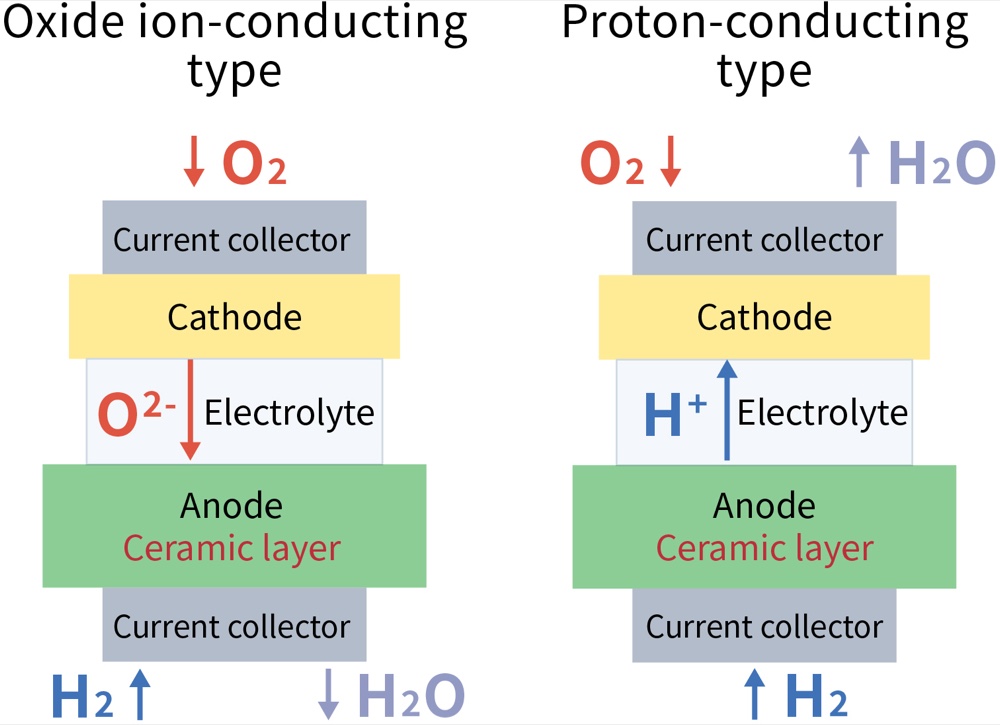
Solid Oxide Fuel Cells (SOFC) are the most efficient type of fuel cells and are attracting attention as a technology to mitigate global warming. There are two main types of SOFCs: oxide ion-conducting (O²⁻) and proton-conducting (H⁺). Currently, the oxide ion-conducting type is the one that has been realized in the world. The proton-conducting type can achieve higher efficiency because the generation of H₂O during power generation occurs on the air electrode side, allowing for higher fuel utilization. We are engaged in research on this proton-conducting fuel cell.
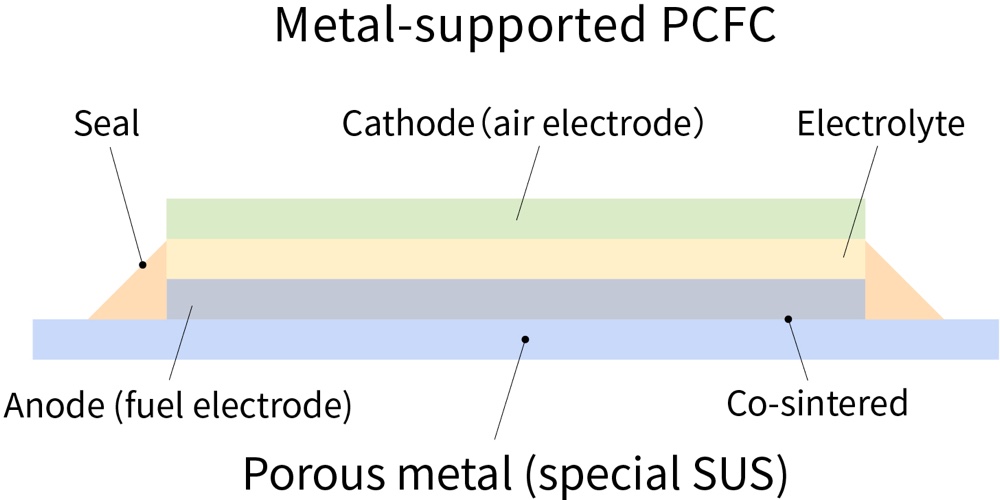
② Metal-supported PCFC
PCFC (Proton-Conducting Fuel Cells) are expected to be highly efficient due to their principle. However, the commonly researched PCFC (anode-supported type) has the following issues:
・It operates at high temperatures, which results in long start-up and shut-down times.
・It experiences significant thermal stress, leading to poor durability.
To address these issues, we are also conducting research on metal-supported PCFCs. By adopting a metal-supported type, performance and cost can be greatly improved, and applications in mobility and hydrogen production are anticipated.
③ Proton-conducting Solid Oxide Electrolysis Cell (PCEC)
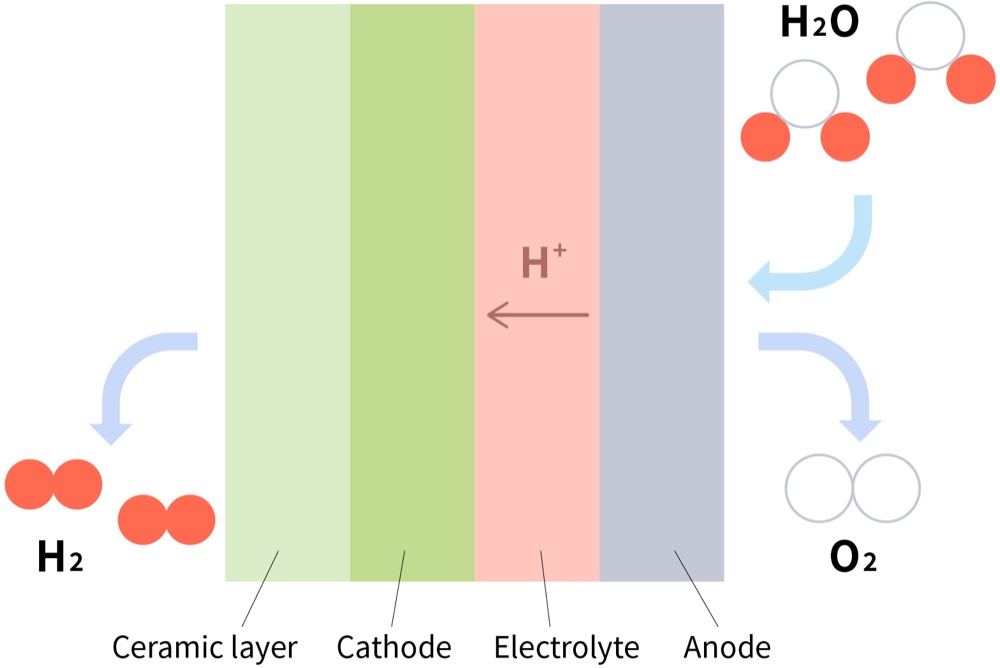
PCEC is expected to be a cost-effective hydrogen production technology due to its lower operating temperature compared to SOEC (Solid Oxide Electrolysis Cell) and the simplification of the system, as no water vapor is present in the produced hydrogen.
However, electron leakage under high oxygen partial pressure, a characteristic of the electrolyte material, is responsible for the decrease in Faradaic efficiency, which remains the biggest challenge.
We are conducting research to address this challenge and establish high-efficiency, low-cost hydrogen production technology.